
Inorganic Seminar - Chun-Ting Li
May
14
2026
Description
The Inorganic Seminar Series presents: Chun-Ting Li
National Taiwan Normal University (NTNU)
Title: Coordination Chemistry: The Ultimate Architecture of Charge Transfer
Location: NHB 1.720
The pursuit of next-generation molecular semiconductors often overlooks the fundamental struggle at the molecular interface. This talk recounts a journey defined by “Three Slaps”—three critical failures in copper-neocuproine redox systems where traditional electrochemistry was paralyzed, and only the rigor of coordination chemistry could provide salvation. First, we demonstrate how overlooked anion residues can “lock” the metal center into electrochemically inert states. This paralysis was resolved by introducing non-coordinating ClO4– to release a rare copper(II) tetrahedral (Td) architecture, which significantly boosted the conversion efficiency in dye-sensitized solar cells (DSSCs) [1]. Second, we reveal a subtle “usurpation” where lithium ions invade the copper coordination sphere, causing seasonal device failure. This was mitigated by strategic isolation, utilizing bulky tetrabutylammonium cations to safeguard the coordination environment. Finally, we address the chaotic charge-transfer behavior at conductive polymer interfaces. A universal diagnosis across thiophene, pyrrole, and aniline-based films showed that the Levich limiting current—the heartbeat of electrochemistry—vanished exclusively on pyrrole-based surfaces. Ex-situ X-ray photoelectron spectroscopy (XPS) analysis identified strong coordination “traps” formed by flexible pyrrole entities that sequester Cu2+ ions. We demonstrate that the insertion of a rigid, well-ordered MOF lattice (Al-TCPP) effectively suppresses these traps and restores fundamental Levich behavior.
Our findings converge on a singular, sovereign conclusion: “The well-ordered lattice governs the return of the limiting current!” This is not just a report of successful data; it is a call for a marriage. When electrochemistry fails, it is a signal for the Coordination Knights to step in. We must move beyond simple collaboration to save the marriage between order and function.
To manifest this union, we introduce the metal–organic chalcogenides (MOC) universe, where crystalline order dictates semiconductive pathways via metal(d)–sulfide(p) orbital overlap. First, the 2D “Sandwich” architecture: honeycomb M–S planes (M= Cu, Ag) provide high-speed electron highways. The [Cu2(6mna)(6mn)NH4]n (6mna= 6-mercaptonicotinic acid) and [Ag2(SePh)2]n frameworks achieved outstanding efficiencies of 9.4% and 10.2% respectively, proving that long-range planar order can overcome interfacial resistance. Second, the 3D "Wine-rack" network: 1D helical M–S ribbons (M= Fe, Co) offer dense catalytic sites. By engineering a bulk heterojunction between 2D-Cu and 3D-Co lattices, we synergized efficient transport with superior catalysis, reaching a benchmark-surpassing efficiency of 10%—outperforming platinum.
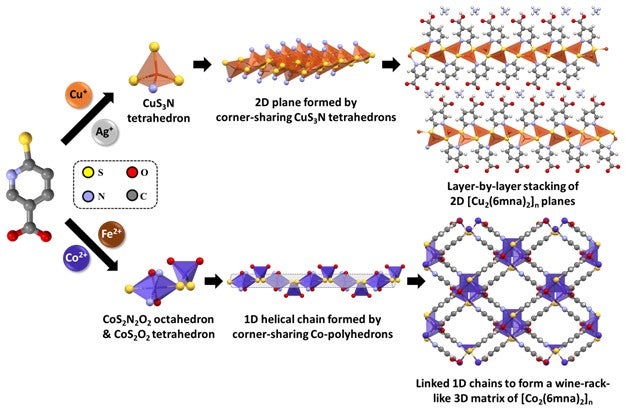
Figure 1. Sandwich-like (upper) and wine-rack-like (lower) metal-organic chalcogenides
[1] (a) X.-B. Lin, C.-Y. Wu, B.-Y. Han, Y.-C. Lee, Y.-F. Lin, S.-R. Li, S.-S. Sun, C.-T. Li*, ACS Appl. Mater. Interfaces, 2024, 16, 61820.(b) C.-W. Lai+, Y.-C. Lee+, Y.-Z. Jiang, C.-H. Lin, G. Kumar, M. H. Huang, C.-T. Li*, J. Mater. Chem. A, 2024, 12, 1595. (c) S.-S. Chu, C.-J. Cheng, X.-B. Lin, S.-R. Li, S.-S. Sun, C.-T. Li*, Electrochimica Acta, 2025, 540, 147124.