
A&P Seminar - Eli Pollak

Nov
30
2026
Description
The Analytical and Physical Seminar Series presents: Eli Pollak
Weizmann Institute of Science
Host: Dima Makarov
Title: After a century – progress in semiclassics and tunneling
Location: WEL 2.122
Refreshments served at 3:15pm
Quantum tunneling was discovered by Hund in 1927 . The semiclassical theory of tunneling was developed by Wigner in 1932 and Kemble in 1935 . Yet, even after a century, quantum tunneling is an enigma. Modern practical algorithms for computing tunneling rates are incorrect even at high temperatures - thermal reaction rates are typically greater than predicted by most semiclassical theories.. The semiclassical low temperature theory of deep tunneling, initiated by Miller in terms of instanton trajectories – periodic orbits moving on the inverted potential, suffered from a divergence at the so-called crossover temperature between tunneling and thermal activation. Kemble’s uniform semiclassical theory predicts wrongly that the transmission probability through a barrier will always be ½ when the energy equals the barrier energy. This is not the case for simple models such as a square barrier or Eckart potentials, yet this “half point” problem remained unanswered.
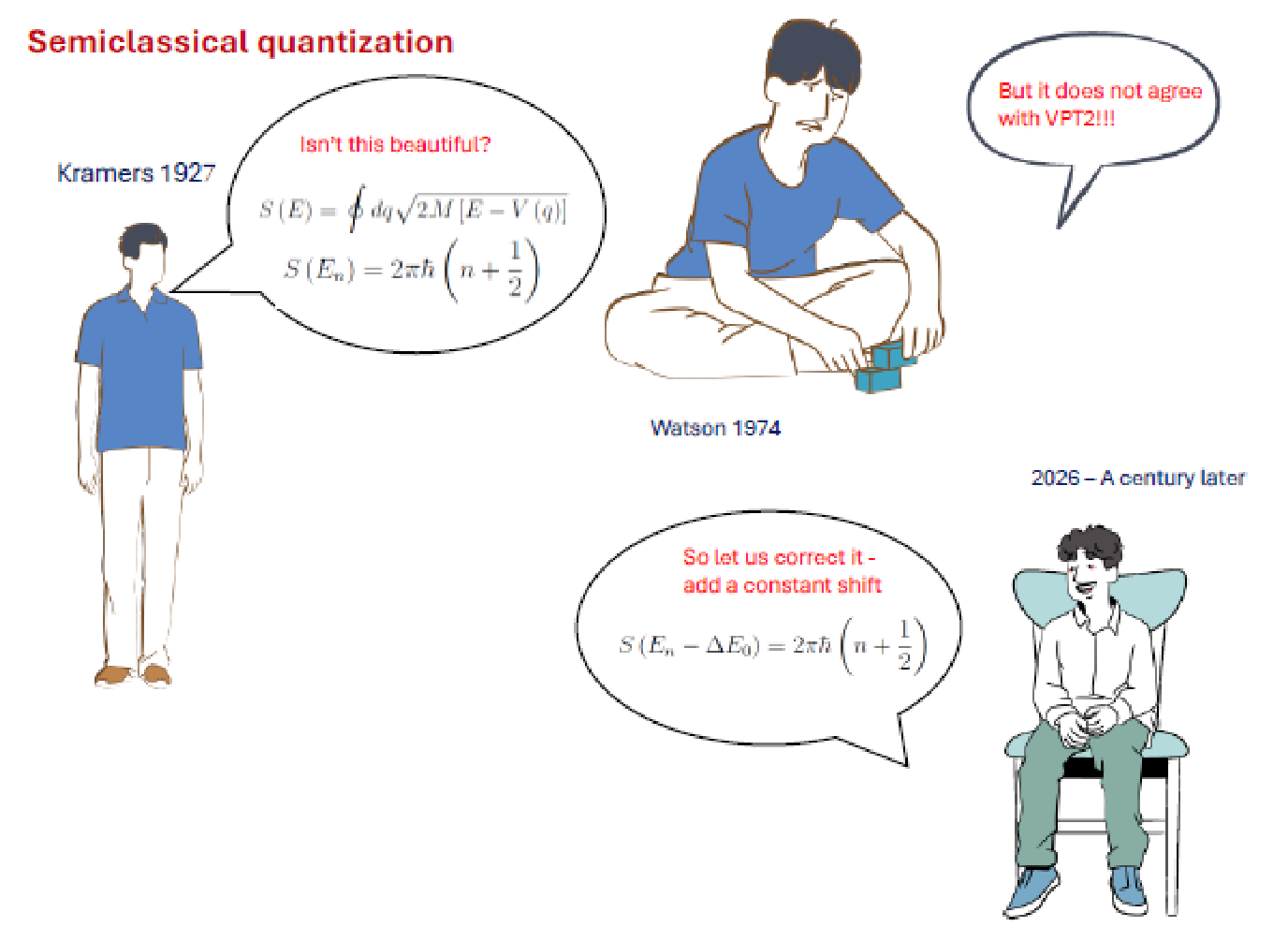
A related topic is the semiclassical quantization of bound state systems. Its origin is in 1927 with the seminal papers of Brillouin, Wentzel and Kramers (BWK theory, also known as WKB theory). Interestingly, as shown by Schatz in 1979 , the BWK rule and its multidimensional generalization (Einstein, Brillouin, Keller quantization) do not agree with second order perturbation theory.
From a practical point of view, the central advantage of semiclassics is that it is based on classical trajectories which depend only on local information from the force field and are thus amenable in principle to ab-initio computations. Another strong point is that semiclassics do not suffer from the difficulty involved in accounting for the quantization of energy levels.
In this talk I will describe our recent solutions to some of the challenges which still faced semiclassical theories. The divergence inherent to instanton theory will be removed , with the conclusion that the crossover temperature between tunneling and thermal activation is twice as high as the one considered by Affleck . The half point puzzle will be solved. Some recent applications and implications of the resulting modern theory of tunneling will be discussed, not the least of which is a critique of present-day numerical algorithms for the computation of tunneling rates . A simple modification of the BWK theory will be presented and discussed. Examples will show that it too can be very accurate even in systems with more than one degree of freedom . All this indicates that semiclassics will continue to be an important tool in predicting and analyzing molecular reaction rates and molecular spectra in the future .
A third topic has to do with tunneling splitting of symmetric molecules. Usually, one uses quantum chemistry to compute the Born-Oppenheimer potential energy surface and then sophisticated methods to solve for the eigenvalue spectrum. In this talk I will review briefly the differences between adiabatic and nonadiabatic tunneling and show that one should expect that non-adiabatic interactions noticeably affect the computations so that even today, we do not have accurate computations of tunneling splitting in a molecule such as malonaldehyde.
[1] F. Hund, Z. Phys. 1927, 40, 742 , Z. Phys.1927, 43, 805 (1927).
[1] E. Wigner, Z. Phys. Chem. 1932, 19B, 203.
[1] E.C. Kemble, Phys. Rev. 1935, 48, 549.
[1] W. H. Miller, J. Chem. Phys. 1975, 62, 1899.
[1] G. C. Schatz and T. Mulloney, J. Phys. Chem. 1979, 83, 989.
[1] S. Upadhyayula and E. Pollak, J. Phys. Chem. Lett. 2023, 14, 9892.
[1] I. Affleck, Phys. Rev. Lett. 1981, 46, 388..
[1] S. Upadhyayula and E. Pollak, J. Phys. Chem. A. 2024, 128, 3434-3448; E. Pollak and S. Upadhyayula, J. Chem. Phys. 2024, 160, 184110.
[1] E. Pollak, J. Chem. Phys. 2024, 160, 150902.
[1] E. Pollak, J. Phys. Chem. Lett., 2026, 17, 896–900.
[1] M. Ceotto, R. Conte, C. Aietta and E. Pollak, J. Chem. Phys. 2026, 165, 114102.
[1] E. Pollak, Comm. Comp. Phys. 2026, 8, 73-82.